Natalia’s Message

When Russia invaded Ukraine, I felt it keenly for reasons I go into below. I wanted to help, I’ve made some donations, but mostly I feel overwhelmingly impotent against gargantuan geopolitical forces. I am certain this feeling is sweeping Europe. I contacted my Ukrainian friend Natalia, because the one thing I can do is amplify the voice of somebody actually living with the reality of the Russian invasion. I’m pleased to say that she is a) reasonably safe and well, and b) wished to share a message.

Jump to post-amble

Jump to what you can do

I’ve edited some parts for clarity (using [brackets], with her consent) but otherwise tried to leave her words alone. Here is a map showing the locations she speaks about.

To all people Robin knows

My name is Natalia, I’m Ukrainian, I’m in the country and I have something to be told. I know it’s hard to think about these horrible things and to realize it’s happening now. I totally understand but at the same time I ask you not to close your eyes now.
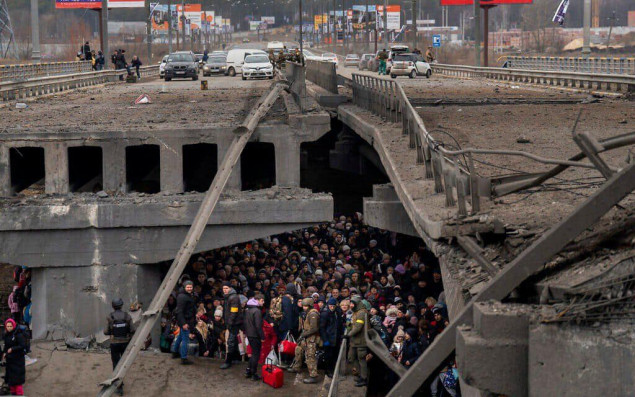
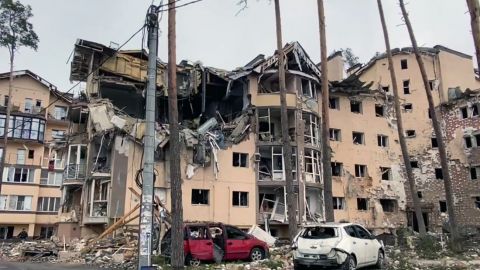
Have a look at the photos from Irpin.

It’s a place near Kyiv – a lovely town where I used to spend time with my friends. My favorite place. We were recording poems in the Writers’ Park recently. See how it looks like now. Why? Can anybody explain?

Look at the video reports from Mariupol. My classmate with her family lives there. People cannot even count the dead bodies now – of civilians, killed by damned Russian rockets, and it is the 21st century! Go fuck yourself, putin’s servants!

Watch what is happening to the cities as Chernihiv and Kharkiv. My friend sitting right here near me is from Chernihiv, a beautiful ancient city. The rockets destroy everything. Her parents live in a basement. I’ve been to Chernihiv recently on my way to this friend in the countryside. I had a big bag with painting materials and bought a better bag there. I remember drinking coffee and walking in the market. Such a lovely city, and I can say no one was interested in Russia there.

Ukraine as a state was not ideal. But I can tell you honestly and without any doubt, that [nobody] was interested in “russian help”. No one I ever knew.

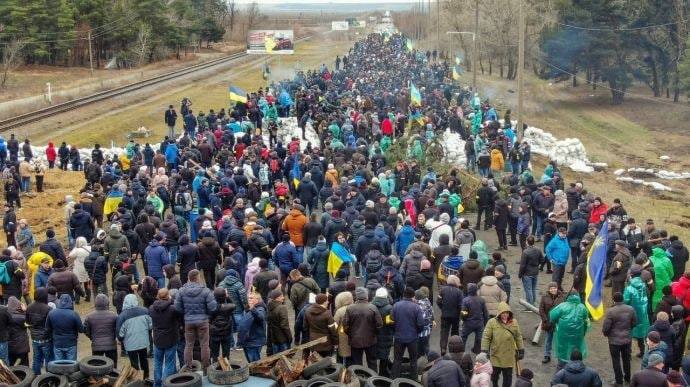
I see how people near me “meet” the occupants. They stay all as one, old people near children, all men and women do anything to help immediately. All are ready to defend themselves. If anyone asks for anything, they immediately get it. And it’s a little village, not any big city with forces and much weapon. And it’s not the west of the country!

Did you see what’s happening in Kherson? This summer I’ve been to the region, we have been on the seaside. Beautiful place, beautiful people. We were buying tomatoes and peaches and playing with local kittens. I can’t [believe now that] we were so happy. I can’t believe the russian soldiers can find any support there. [These] people (=antipeople) thought everyone is waiting for their “help” but look what happened when they managed to come to the city Kherson. Just see the video. No words needed. Russians were shooting in the air, but people stayed.

Have you seen how civilians came in front the [equipment and weapons] in Enerdogar to stop them? My heart is exploding by love to them and respect. Unfortunately, they started shooting in civilians.

Believe me we are not interested in these totalitarian values which the enemy wants to impose. It’s psycho. It’s a clinic for mentally ill. And we don’t need them here.
It’s not about politics, it’s about humanity, freedom, and morality. And safety of Europe.
And we will stand. Please support us in the military area, if you can’t, close your business with Russia. They must feel it. No time for tolerance or counting money. Other way it can cost more.

Thank you! Together we are stronger! Life is unstoppable.

Places described above:

The Writers’ Park, recently, Irpin

Irpin now:
Kherson after invasion:
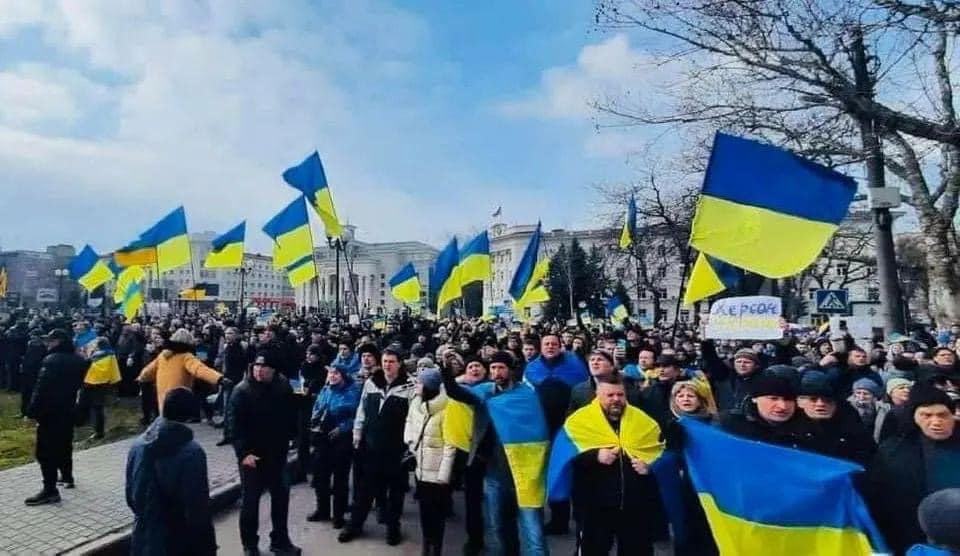
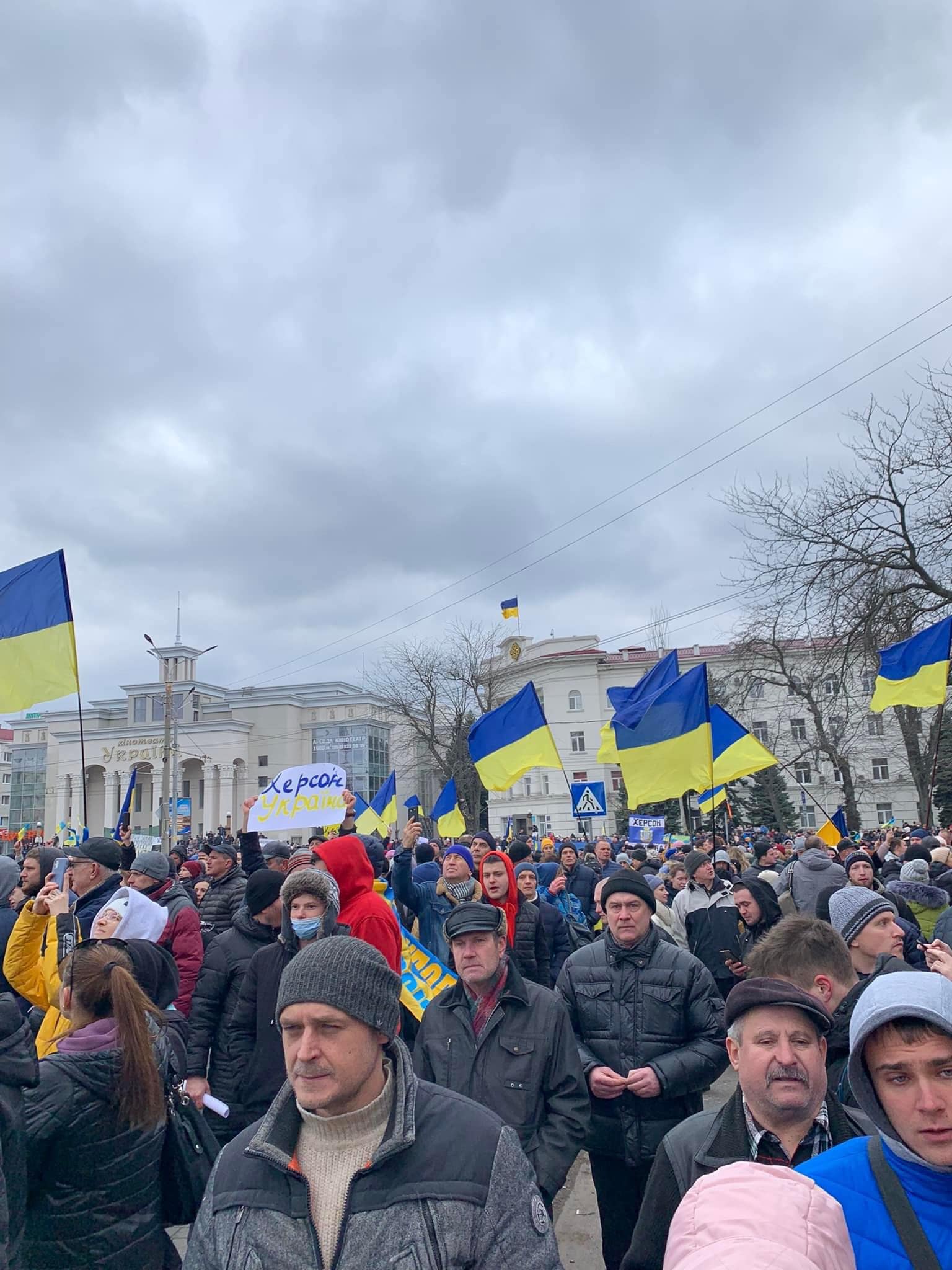

Video of Kherson after the invasion (Facebook link)

Enerdogar civilians in front of the armed forces:
What you can do:
supportukrainenow.org
RazomForUkraine
How-to-support-Ukraine

Financial support for the Ukrainian Armed Forces:
https://bank.gov.ua/en/news/all/natsionalniy-bank-vidkriv-spetsrahunok-dlya-zboru-koshtiv-na-potrebi-armiyi

Post-amble

I speak Esperanto. Without going into too much detail about it, Esperanto is a constructed language, a hobby, a worldview, and something that encourages speakers and enthusiasts from all over the world to meet up. When I was learning, I discovered all these things, it became more than a curiosity to me, and I got sucked in. I attended several congresses, one of which, in 2011, was in Kyiv, Ukraine.

I found my time there to be an incredibly valuable, eye-opening experience in ways that merit their own blog, but that’s not what this is about. The Congress took place in a hostel where most of the participants (including me) were staying. There I met Natalia. As a local, she had been involved in running some of the planned classes and excursions, and from her I learnt exactly one sentence of Ukrainian (dayte, budʹ laska ukrayini vodka), and was introduced to Kvass (which I’ve been scouring local Polish shops for and telling local brewers about ever since). We were both involved in a play that was going on, and we had a friendship for the few days I was there. Apart from one or two messages, I’ve not really spoken to her since. As I said above, the Congress provided me with experiences I could probably not have found anywhere else, in a beautiful country, and has been a fond and formative memory for me. I’m glad to be back in touch with her, but sad that it is in these circumstances.

Maybe it shouldn’t be this way, but you always care more about places you have some connection to. Please forward Natalia’s message to help forge more of a connection to the people of Ukraine.
Black Lives Still Matter

I normally post links in blogs as much as possible. In looking for web presences, I noticed that some organisations were surprisingly hard to find. It has struck me that that might be by design, so I’ve stripped the links.

My fairly shonky video is here. I think the speakers are worth hearing in person, rather than getting a second-hand impressions from a white bloke’s blog.

I only found out about this by accident – it was not nearly as publicised as the College Green protest. I’d gotten in touch with a local Esperanto speaker to see if we could chat (I’ve been speaking it for ten years and it’s a part of my brain now, I need to keep my hand in), and it turned out that they were going to the protest, which was less than a mile from my house! Double win. Language nerdery and political education.

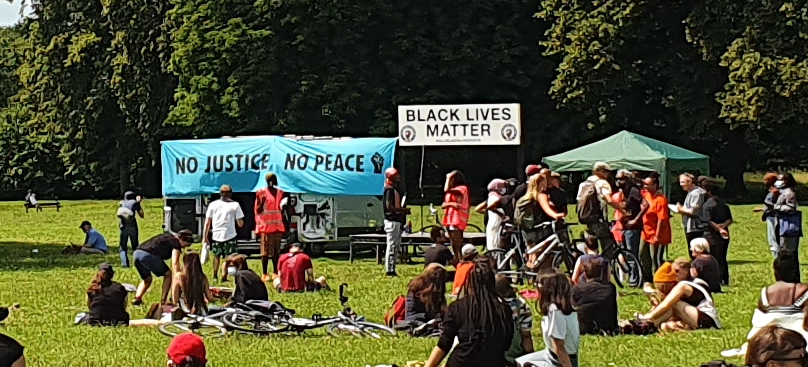
Attendance was 3-400 when the speakers began, maybe up to 5-600 at peak. That’s an educated guess based on seeing Park Runners in the same space in the before time, but suffice it to say, it was pretty easy to distance and still be close enough to the front to hear. The atmosphere was peaceful and positive, so the police presence – two mounted officers, another group of three on foot, and two PCSOs that I saw – looked to be at a loose end. There were more police further up the hill, near what looked like a traveller camp. Interesting timing. There also seemed to be a lot more women there than men, although I was hardly running a census.

There were eight stalls for local political and community groups: Acorn the Union (tenants union), Black Community Rising (anti-capitalist group), Interculture (with a How To Be An Ally stall), Sunkissed Youth jewellery, Socialist Worker, Shola Knits, Bristol Antifascists, plus Bristol Defendant Solidarity & Bristol Copwatch.

The protest consisted of a series of talks, first from invited speakers, then the stalls present, then the mic was opened to on-the-day sign-ups. Other local community groups were also represented, as well as those individuals who simply felt moved to speak. There was also singing and poetry, some of which I found impressive, powerful, and really moving – I became a fan of some slam poets that day.

There were many calls for unity within the black community and encouragement of mutual support. In particular, there was a push for more LGBTQ+ representation and acceptance. “Black Trans Lives Matter” was impressed upon us more than once. One speaker said “I did not become white when I came out“. Black men were called upon to step up for black women. Intersectionality, unity and critical assessment of attitudes within the community were common themes.

The Green party was heavily involved with the day, and the politics was generally (and unsurprisingly) radical left. Cleo Lake called for change in the “seat of privilege” – private schools – in the form of a year-round black history curriculum. Others spoke of the erasure of black scientists, artists and engineers from history (for example the inventor of the carbon-filament lightbulb) as limiting what black people can be. Funding disparities were highlighted – “the hall formerly known as Colstonhas received £10m from the council to secure its future, while black cultural centres have received nothing. Several speakers drew attention to continued existence of the colonial mindset: “homophobia is the product of the coloniser” – “there is a contradiction between saying ‘black lives matter’ and buying from Amazon” – “the UK wants to take what they want from black culture and throw away what they don’t like“. I like to think I’ve had some awareness of these truths, but I was given pause for thought when it was suggested that colonialism can be found in “the monkey on the Coco Pops” (on a related note, how does Um Bongo still exist?)

Many speakers just spoke from their own experiences as members of the 3% of the UK who are black. Christians, actors, professors..some had more traditional, or religious views, which informed where they saw a future for black people worldwide. Others just spoke about how their own standards had been affected by the subtle racism and colonial attitudes ubiquitous in mainstream media. Allies were acknowledged, but it was a black-organised event for black people, which was politely made clear. In case anyone is in danger of misunderstanding me – I did not feel anything but welcome as a very white guy.

Generally, a huge variety of worldviews were represented, and while not all of these views were necessarily reconcilable, there was universal enthusiasm for not letting differences slow the general advancement of the BLM cause. I think I remember only one speaker saying that “black people are tired“, but honestly, no-one here seemed it. Everyone seemed indefatigable, and prepared to do whatever it takes to achieve justice and equality – “we tried to get rid of the statue of Colston politically but couldn’t – you all know how that ended.

Note: Mostly, I write this blog to further my own education and give others a sense of an event with as little spin as I can manage. I tried to report this as sensitively as I could, because I recognise I am re-using the words of a community which I do not belong to or represent. If anyone who attended or was involved with the event has any comments or thoughts on this, I’d love to hear from you.

Black Lives Matter protest/Eddie goes swimming

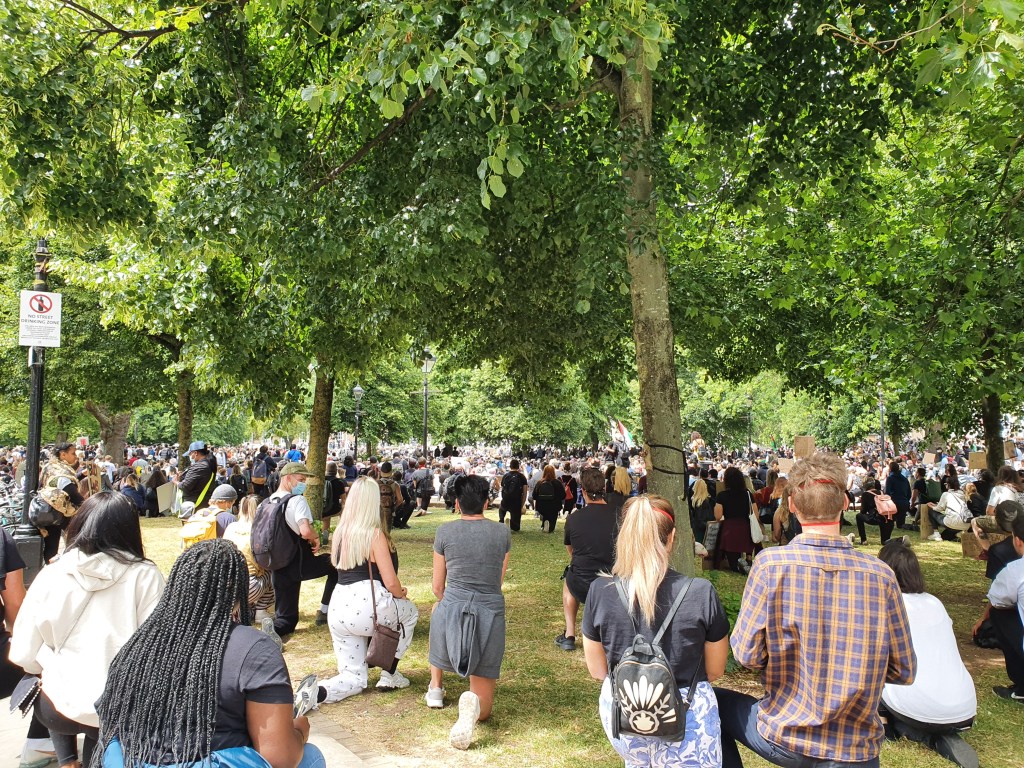
My partner and I spent about 24 hours on-and-off debating whether or not to attend the BLM protest on College Green in the midst of a badly-handled pandemic. Given that we are sharing a house, one of us going still exposes the other to risk, so we had to compromise. We eventually decided to attend to the extent that we could without being caught in a throng of people. This meant staying near the statue of Queen Victoria for the duration of the speakers, then leaving before being caught in the march. I’m aware that this may only have felt like a choice for us because we are white. I don’t know what the right answer was here, if there was one at all.

Masks were worn by the majority of people (although not all police, disappointingly) and distancing was observed to some extent (although plenty of people were ignoring it, which rather negates the efforts made by the rest of us). Given where we were, I learned two things:

  1. You can’t hear anything back there. I could hear that people were speaking, but not what they were saying. I will have to rely on other people’s videos in order to find out what was said. I turned up to be counted, so I clapped when others clapped, and knelt when others knelt.
  2. Kneeling for any length of time on flagstones is pretty uncomfortable. I assume this was a tribute to the protests of Colin Kaepernick, but given that I couldn’t hear anything, I don’t know for certain. This had a solemn, almost funereal feel to it.

The atmosphere was calm, respectful and peaceful..at this point.

Downfall of a slaver

After we had left, we saw footage of the statue of Edward Colston being toppled and rolled in to the floating harbour next to Pero’s Bridge (named for the slave Pero Jones).

Just last Friday, I was having a semi-drunk but fairly nuanced discussion in the Zoom Arms about the merits of changing the name of Colston Hall. I tend to be gun-shy about the destruction of ugly parts of our history – I worry that it makes denial and revisionism too easy. But nuance followed Colston into the river today. The debate having been resolved by an act of direct democracy, I don’t think I feel the slightest bit bad about it. As pointed out by many twitter users, it’s been a teachable moment. Here is what I have learned:

Edward Colston was an MP, a philanthropist, and sold somewhere in the region of 80,000 human beings for profit. An estimated 20% of them died en route. “Philanthropy” literally means “the love of humankind”, by the way.

Acknowledging the whole man would have lent some weight to the argument for keeping his statue where it was, but I also learned that the original plaque neglected to mention his involvement in the slave trade (which had been banned for almost 90 years in the UK by the time the statue was erected in 1895). This fairly transparent attempt to rehabilitate his reputation by omission reminds me of a joke.

It’s hardly ancient history, either. When the slave trade was abolished, slave owners whose former “property” was now walking around free were compensated for their “loss” to the tune of 20 millions pounds. Paying rich people to do the right thing – plus ca change. The British public bought the freedom of slaves with a loan which Bristolians (amongst others) were still paying back in 2015.

Understandably, there has been a long-running campaign (and some less formal action) to see the historical perspective corrected with a second plaque. Which, less understandably, encountered pushback. Indeed, a Tory councillor seems here to be advocating theft of the second plaque. I have to question why one would attempt to mask a person’s connection to the slave trade. I can’t think of a good reason.

So it’s slightly more understandable that people would decide to cut through the red tape on this issue, whether opportunistically or planned.

Currently, I don’t see this as an erasure of history. Today has been an explosion of history. This act was a message, a blow in the battle for Bristol’s soul, and the latest instalment in a story that is still being written.

State of play as lockdown is eased

Figures taken from worldometer.

The UK entered lockdown on March 23rd of 2020. On this day, 967 new cases of Coronavirus and 74 deaths were reported.

Yesterday, May 31st, the UK saw 1,936 new cases of Coronavirus and recorded 115 deaths .

Today, June 1st 2020, lockdown has been considerably eased. Groups of 6 from different households are allowed to meet, with no obvious restriction on the number of such gatherings an individual can attend in succession. The devolved governments of Wales and Scotland are maintaining stricter measures.

We have roughly twice the daily new cases now as when we entered lockdown, but Boris Johnson’s government have proceeded anyway, despite warnings from members of SAGE that it is still too early to do so.

This isn’t over by a long stretch. There is no cure, no vaccine, and the government is beginning to withdraw the one defense we have while the situation is worse than when we first implemented it.

We are 0.87% of the world’s population. We have had 4.35% of the world’s cases, and 10.36% of deaths.

Greta Thunberg attends the Bristol Climate Strike

First up, I filmed all the speakers and posted it here. Greta is the little yellow dot in the last five minutes. I’m not going to go in-depth on the content of the speakers here, I’m just going to give a summary of my impressions. The video does a reasonable job of this anyway.

I negotiated to work some weird hours this week so I could attend the climate strike on College Green. Eight days prior, it had been announced that Greta Thunberg, the next best thing to Captain Planet, would be speaking, so I made a point of attending. By the organisers’ own account, it had been a scramble to prepare for the upsurge in interest on such short notice, but that wasn’t evident to me.

Rivers of people were flowing up towards the green from the centre, at final count between 15k and 30k, depending on who you ask. There were as many umbrellas as placards, and the wet was keeping people to the paths to some extent, but there was no shortage of enthusiasm. Unsurprisingly, working-age people were not well-represented. When I had pushed forward as far as I was able, I ended up near a fairly vocal Green Party contingent, families, school-aged people and older people.

I couldn’t see much, but the PA system was plenty loud (playing Journey and the Bee Gees, I wonder whose playlist that was..). A sign language interpreter was interpreting throughout. There was probably no better symbol of the defiant optimism of the event than the massive solar panel standing proud in the pouring rain on a dark, grey day.

All the speakers preceding Greta were young, female, confident and well-informed. Francis from UKSCN, Mya-Rose Craig (aka “birdgirl“), and Katie Climate spoke on subjects including political action and wins for the movement, the human costs of climate change and green technologies, and the nefarious ways in which vested interests are trying to shift blame from polluters to individuals. I encourage you to watch them and not just skip to Greta.

Greta was a polished and emotive speaker – even more impressive considering she is an autistic person speaking in a second language. Hers was largely a motivational and brief speech. In keeping with the rest of the day, it was more about putting fire in people’s bellies than persuading anyone who might be on the fence about the necessity for action. But drawing attention to the cause was the point of the march.

Keir Starmer visits Bristol East

I have joined the Labour party. This is more or less my natural political home, but I had been reticent to nail my colours to the mast prior to the Boris-pocalypse. I have joined specifically to have a say in the leadership election.

My local MP, Kerry McCarthy, has come out in support of Keir Starmer in the Labour leadership race and invited him to speak locally, so I signed up and attended. This is the first Labour meeting I have attended, but the murmured consensus seemed to be that it was packed. It appeared to be standing room only.

I decided to take “minutes”. Hopefully these are of interest. I have tried to faithfully represent what he put across, but this is second-hand and I in no way claim to represent him! It is also written hastily. So..sorry.

In his opening he stressed that Labour had to be totally focussed on the next election from the off and that “we need a radical Labour government”. “In opposition, we are not changing lives,” was the frame for his ambitions for the party as leader. He gave the impression of not wanting to move particularly far away from the 2019 manifesto, repeatedly stressing local investment, funding of public services, and the green new deal, although conceded at one point that 2019 promised so much that it did not seem credible.

He laid out 3 headline points that Labour needs to adopt to win power. They were:

  • To be united as a party. Sounds obvious, but given the tooth-and-nail Blairite/Corbynista rowing in the party, numerous cabinet re-shuffles, and accusations of bullying from the top, the point bears repeating. Starmer suggested that this would be demonstrated from the top down, with the rest of Labour “not behind me, but beside me”. He absolutely hammered this message throughout and is obviously seeking to be seen as the pro-unity candidate. He cited his credentials for bringing people together under his leadership as his 5 years at the Crown Prosecution Service as Director of Public Prosecutions, and his time as shadow Brexit secretary, in which, as he quite fairly pointed out, he had the task of uniting a party where no two MPs shared the same opinion under a common Brexit strategy. Given Labour’s lack of clarity on the issue you can make your own mind up as to the efficacy of the strategy, but he certainly did have a job to bring people together..
  • Effective opposition. To applause and cheers, he spoke on how the last three PMs have been terrible. But Boris, he contested, is the worst, because he has no principles and will go where he needs to (the right) in order to maintain his grip on power. “Boris is dangerous”. For that reason, Labour needs to win the argument from the despatch box, and hold the Tories to account at every stage.
  • Forge the way to victory. This final point contained substantially more detail. Labour needs to be looking to the next election now – I took this to mean to be effectively in campaign mode immediately, looking like a proper party. Specific tenets were:
    • Don’t trash the achievements of the last Labour government – they were, after all, actually in power and did achieve things that weren’t blowing up Iraq
    • Don’t trash the last 4 years, because it’s left Labour as the anti-austerity, pro-green new deal party
    • Respect the work done at the local level by councillors and mayors, devolve more power
    • Recognise that the free market will not act in the best interests of the country and actively seek to curb its influence and damage using government intervention. See Q&A: 8
    • “What is bad for the environment is bad for the economy”. Again, see Q&A: 8
    • “Party of internationalism” – a push for “peace and justice” on the world stage and a human-rights based approach to the arms trade and foreign policy.

Q&A

  1. Drugs: Has seen close-up the human misery caused by the drugs trade and trafficking in his work as a Barrister and for the CPS. While he is not in favour of decriminalisation (which would be an easy win in Bristol..) he expressed that addiction should be framed as a health and mental health issue. He has in the past supported trials by the police into not making arrests for non-serious drugs offenses.
  2. PR: He is not closed to the discussion but believes representation at the constituency level to be very important. This gives me hope that he might be amenable to something like the New Zealand model.
  3. Labour Unity: End factionalism and be a more tolerant party. Gave an anecdote of young, enthusiastic new members attending meetings once and then being put off by a “1950s agenda”. Stressed modernisation, inclusivity and being welcoming. For the how? part part of this question, he espoused a “make a decision and be a model of it” approach. He referred to his CPS and shadow Brexit secretary experience of finding united views. He seems to really believe in his own ability to do this.
  4. Shadow cabinet/only male candidate: He said he was proud to be amongst such strong candidates as he recognised the bravery it takes to step forward into the contest. There was no sniping and no put-downs. He wanted to use candidates’ solidarity as a blueprint for cabinet unity, and spoke of always putting Labour’s strongest talent up front, in parliament and in public. That way, whenever a member saw a Labour MP, it would always be someone they can be proud of.
  5. Winning back Scotland, given their Brexit stance: Go to Scotland, work with the trade unions and local parties to understand their issues and the solutions. Rejoining the EU is not the focus as we are still fighting to mitigate the damage of Brexit itself. He made particular reference to potential US overreach into public services in trade deals.
  6. Funding for survivors of violence against women and girls: Described the current situation as “short term, patchy, and chronically underfunded.” Decried the lack of consistent national standards of services for VAWA survivors. Made the specific point that women are expected to attend a police station to report DV, yet hardly any do – there ought to be safe places for women to report.
  7. Reemergence of nationalism: Began with an apology to the EU national who asked the question for lack of clarity on his situation post-Brexit. Would legislate for rights. Gave anecdote about a woman who asked if she should just “go home now” rather than enrol her child of 5 in the local school only to have to leave in a year. Windrush: the attitude of innocent until proven guilty and trying to catch people in a lie that is currently held by the home office must change. Extended that sentiment to the DWP, stating that the DWP presume people attempt to cheat and therefore need to be assessed.
  8. Green new deal: Wishes to stay committed to it. Says the government must force the free market to act in a way that is better for the environment, such as carbon-neutral homes, and general decarbonisation policies. On the climate crisis mentioned green public transport, specifically Bristol’s new biogas buses.
  9. LGBT+: “Totally committed”. Pointed out that Labour decriminalised homosexuality. Made a point of mentioning how many of the UK’s former colonies (Jamaica, Uganda, India, etc) have anti-gay laws on the books because they simply took on UK legislation. Can’t remember his actual point to that, although he has worked in Jamaica in his legal career so I am reassured that he is well informed. Said that despite acknowledging the strong views on the subject, trans rights were no longer to be used as a “political football”.

He seemed genuine in his beliefs and never obviously floundered in the Q&A. Human rights are a motivating factor that he mentioned repeatedly. He was committed to a radical Labour party, saying that the country needs it.

I was as impressed by him here as I have been with his performance in Parliament. He was sharp, confident, and well-informed. I didn’t get the sense that he was power-hungry, but that he genuinely believed he could unite the party.

Design a site like this with WordPress.com
Get started