I normally post links in blogs as much as possible. In looking for web presences, I noticed that some organisations were surprisingly hard to find. It has struck me that that might be by design, so I’ve stripped the links.
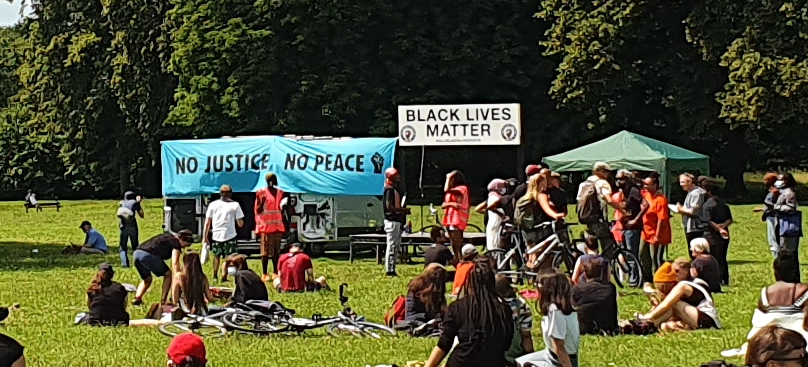
This was quite early on, but the event was not heaving at any point.
My fairly shonky video is here. I think the speakers are worth hearing in person, rather than getting a second-hand impressions from a white bloke’s blog.
I only found out about this by accident – it was not nearly as publicised as the College Green protest. I’d gotten in touch with a local Esperanto speaker to see if we could chat (I’ve been speaking it for ten years and it’s a part of my brain now, I need to keep my hand in), and it turned out that they were going to the protest, which was less than a mile from my house! Double win. Language nerdery and political education.
Attendance was 3-400 when the speakers began, maybe up to 5-600 at peak. That’s an educated guess based on seeing Park Runners in the same space in the before time, but suffice it to say, it was pretty easy to distance and still be close enough to the front to hear. The atmosphere was peaceful and positive, so the police presence – two mounted officers, another group of three on foot, and two PCSOs that I saw – looked to be at a loose end. There were more police further up the hill, near what looked like a traveller camp. Interesting timing. There also seemed to be a lot more women there than men, although I was hardly running a census.
There were eight stalls for local political and community groups: Acorn the Union (tenants union), Black Community Rising (anti-capitalist group), Interculture (with a How To Be An Ally stall), Sunkissed Youth jewellery, Socialist Worker, Shola Knits, Bristol Antifascists, plus Bristol Defendant Solidarity & Bristol Copwatch.
The protest consisted of a series of talks, first from invited speakers, then the stalls present, then the mic was opened to on-the-day sign-ups. Other local community groups were also represented, as well as those individuals who simply felt moved to speak. There was also singing and poetry, some of which I found impressive, powerful, and really moving – I became a fan of some slam poets that day.
There were many calls for unity within the black community and encouragement of mutual support. In particular, there was a push for more LGBTQ+ representation and acceptance. “Black Trans Lives Matter” was impressed upon us more than once. One speaker said “I did not become white when I came out“. Black men were called upon to step up for black women. Intersectionality, unity and critical assessment of attitudes within the community were common themes.
The Green party was heavily involved with the day, and the politics was generally (and unsurprisingly) radical left. Cleo Lake called for change in the “seat of privilege” – private schools – in the form of a year-round black history curriculum. Others spoke of the erasure of black scientists, artists and engineers from history (for example the inventor of the carbon-filament lightbulb) as limiting what black people can be. Funding disparities were highlighted – “the hall formerly known as Colston” has received £10m from the council to secure its future, while black cultural centres have received nothing. Several speakers drew attention to continued existence of the colonial mindset: “homophobia is the product of the coloniser” – “there is a contradiction between saying ‘black lives matter’ and buying from Amazon” – “the UK wants to take what they want from black culture and throw away what they don’t like“. I like to think I’ve had some awareness of these truths, but I was given pause for thought when it was suggested that colonialism can be found in “the monkey on the Coco Pops” (on a related note, how does Um Bongo still exist?)
Many speakers just spoke from their own experiences as members of the 3% of the UK who are black. Christians, actors, professors..some had more traditional, or religious views, which informed where they saw a future for black people worldwide. Others just spoke about how their own standards had been affected by the subtle racism and colonial attitudes ubiquitous in mainstream media. Allies were acknowledged, but it was a black-organised event for black people, which was politely made clear. In case anyone is in danger of misunderstanding me – I did not feel anything but welcome as a very white guy.
Generally, a huge variety of worldviews were represented, and while not all of these views were necessarily reconcilable, there was universal enthusiasm for not letting differences slow the general advancement of the BLM cause. I think I remember only one speaker saying that “black people are tired“, but honestly, no-one here seemed it. Everyone seemed indefatigable, and prepared to do whatever it takes to achieve justice and equality – “we tried to get rid of the statue of Colston politically but couldn’t – you all know how that ended.“
Note: Mostly, I write this blog to further my own education and give others a sense of an event with as little spin as I can manage. I tried to report this as sensitively as I could, because I recognise I am re-using the words of a community which I do not belong to or represent. If anyone who attended or was involved with the event has any comments or thoughts on this, I’d love to hear from you.
 Fool Rushing In